
Indianapolis Traffic Ticket Records
Indianapolis traffic ticket records are handled by the Marion County Traffic Division, which processes hundreds of thousands of cases each year for the state's capital and largest city. You can search records online using Indiana's MyCase portal, pay fines through the city's payment site, or visit the Community Justice Campus in person. This page covers how to find your ticket, what payment options exist, what to do if you want to contest a citation, and where to get help with your driving record.
Indianapolis Quick Facts
Which Court Handles Indianapolis Traffic Tickets
Traffic citations issued in Indianapolis go to the Marion County Traffic Division. This division operates as part of the Marion County court system and handles infractions, moving violations, and traffic-related misdemeanors. The Traffic Division sits under the broader Marion County court structure. If you got a ticket anywhere in Indianapolis city limits, Marion County handles the case.
The main court address is the Community Justice Campus at 675 Justice Way, Indianapolis, IN 46203. A second location is Room W122 at the City-County Building downtown. Both handle traffic matters, but the Justice Way campus is the primary site for in-person visits.
Tickets marked as "summons" work differently. Those will not appear in the online system right away. You'll get a court summons by mail telling you when to appear. Do not try to pay those online. Wait for the paper notice.
How to Search Indianapolis Traffic Ticket Records
Indiana's public court search tool is called MyCase. It's free to use and covers courts across the state, including all Marion County traffic cases. You can search by name and date of birth or by ticket number.
The Indiana MyCase portal (https://public.courts.in.gov/mycase) lets you search by name and date of birth. You can pull up case details, check hearing dates, and see what fines are listed. Indiana courts operate under IC 5-14-3, Indiana's Access to Public Records Act, which makes most traffic case records available to anyone who asks. MyCase puts that access online for free.
The city also has its own traffic ticket search at https://www.indy.gov/activity/pay-traffic-ticket. That system lets you search by ticket number (the UTT number printed on your citation) or by name and date of birth. Payments made online take up to 48 hours to show up in the system.
The MyCase portal covers the screenshot below. The site is the main statewide tool for finding court records. It covers all 92 Indiana counties.
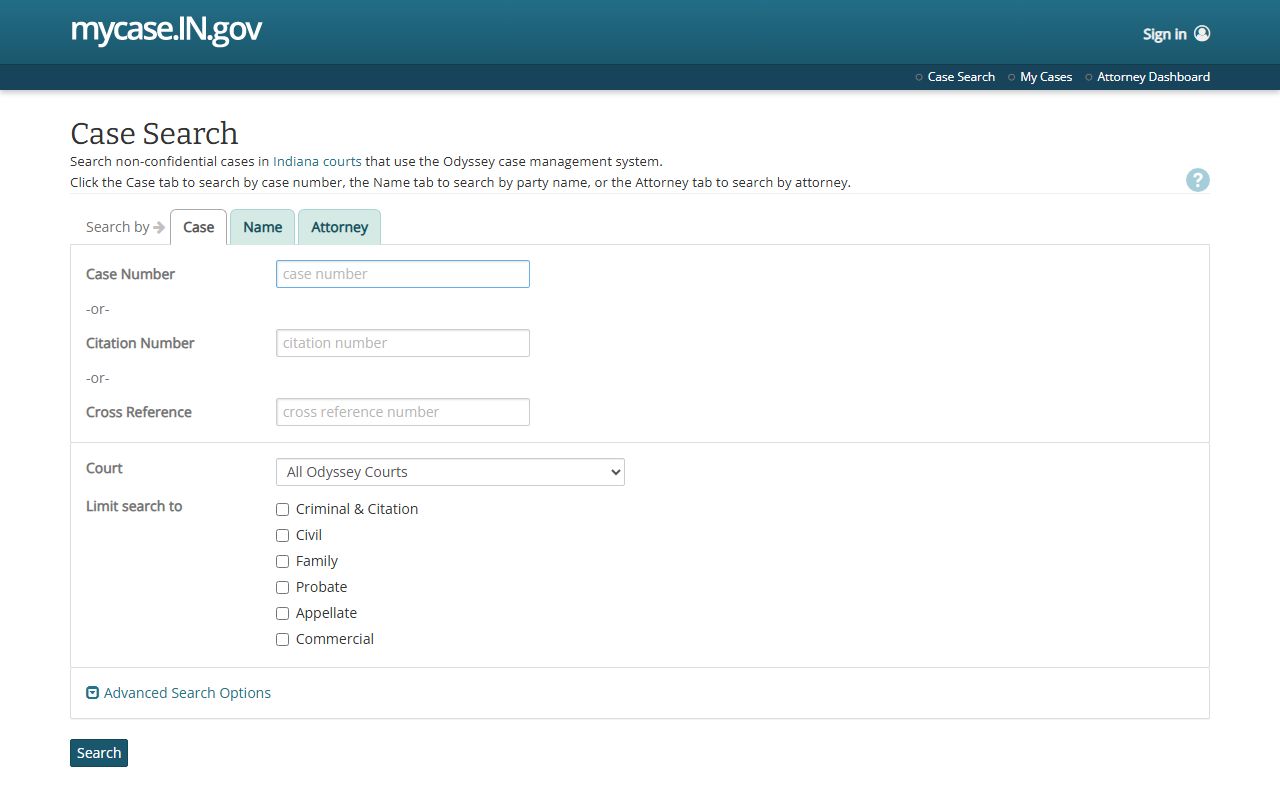
MyCase shows case numbers, hearing dates, charges, and whether a ticket has been paid or dismissed. Use the search tab on the left to enter a name or case number. Results load quickly and show the court where the case is filed.
How to Pay an Indianapolis Traffic Ticket
You have four ways to pay. Online is the fastest. In person is the most flexible for payment types. Mail works if you send the right documents. Each option has slightly different rules.
Online payment: Go to https://www.indy.gov/activity/pay-traffic-ticket. You can pay with a debit or credit card. Allow 48 hours for the payment to post. Do not wait until the last day to pay online.
In person: Head to the Community Justice Campus at 675 Justice Way. The other option is Room W122 at the City-County Building, 200 E. Washington Street. Hours are Monday through Friday, 8 a.m. to 4 p.m. Both locations accept cash and cards.
By mail: Send a money order or cashier's check to Marion County Traffic Division, 200 E. Washington Street, Indianapolis, IN 46204. Include a copy of your ticket. Do not mail cash. Personal checks may not be accepted for all ticket types.
The due date on your ticket is 60 days after you received it. Pay before that date to avoid a late penalty. If you miss the date, your case may be escalated to a failure-to-appear situation, which adds costs and can affect your license.
The Indiana courts payment portal also works for some Marion County cases. See the screenshot below for what the payment site looks like.
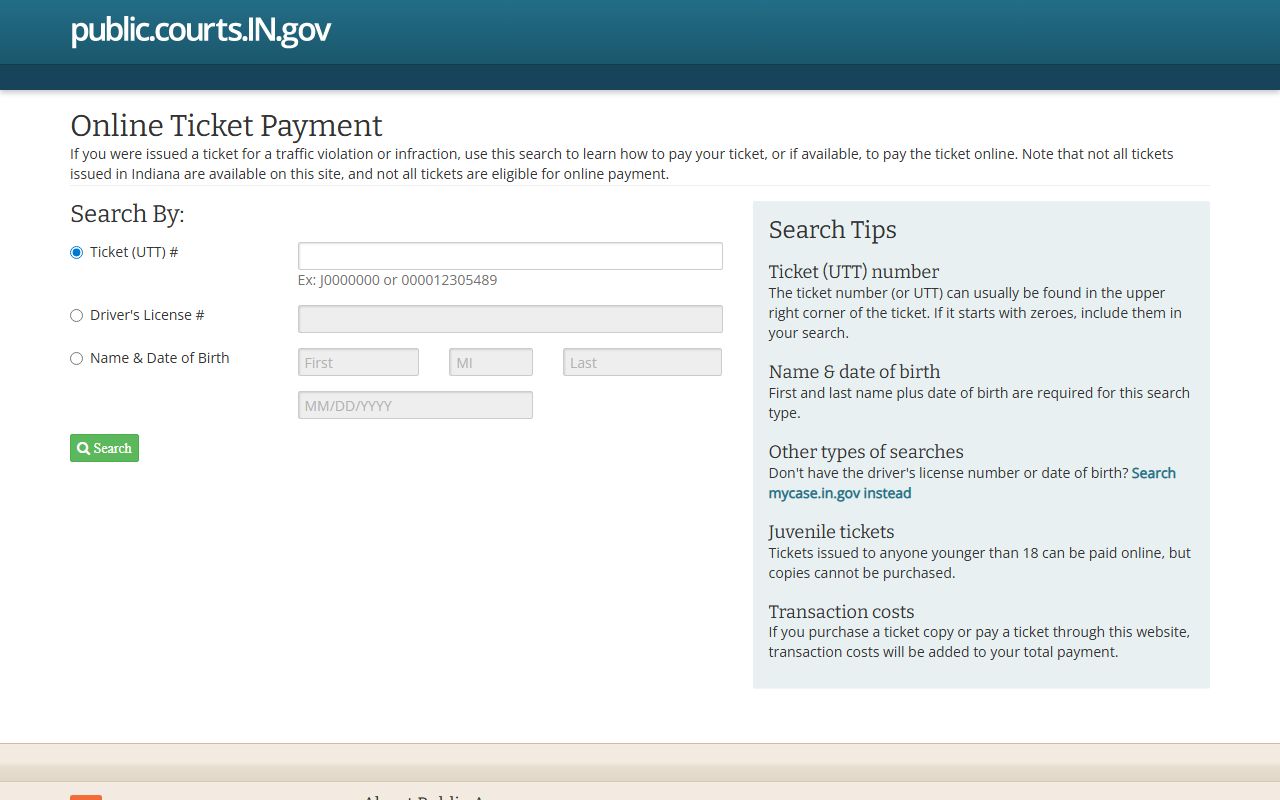
The payment portal lets you search by case number or ticket number. Once you find the case, select the amount due and enter card details. Print or save the confirmation number when done.
Deferral Programs and Court Dates
Indianapolis offers two deferral programs for drivers who want to keep a ticket off their record.
The Safe Driver Deferral Program costs $229. You pay the fee and agree to have no moving violations for six months. If you meet that condition, the ticket does not go on your driving record. Email MCPO.Ticket@indy.gov to ask about eligibility and apply. This program is not available for all ticket types, so ask before you assume you qualify.
The Paperwork and Equipment Deferral is for correctable violations like a missing registration sticker, broken tail light, or expired insurance card. Get the issue fixed, show proof, and the citation may be dismissed or reduced. Contact the court by email at MCPO.ticket@indy.gov to ask how to proceed.
If you want to fight the ticket, you can set a court date. Call (317) 327-5738 or visit the Traffic Division. You must appear on the date set. Indiana law under IC 9-30-10 covers procedures for drivers who fail to comply with a traffic citation, including license suspension for non-payment or non-appearance.
Indiana Traffic Laws and BMV Points
Indiana speed laws fall under IC 9-21-5. Speeding is one of the most common reasons people receive tickets in Indianapolis. The state uses an absolute speed limit system. Going even one mile per hour over the posted limit is a violation.
Indiana's BMV tracks driver points. Each moving violation adds points to your record. Minor speeding adds 2 points. More serious violations like reckless driving can add 8 points or more. At 18 points in two years, your license gets suspended. You can check your current point total by logging into mybmv.com.
Driving while suspended is covered under IC 9-25-8. Operating without proof of financial liability (insurance) is also a serious charge that can lead to license issues. If your ticket involves either of those charges, you may need to appear in court rather than just pay online.
Operating while intoxicated laws are in IC 9-30-5. OWI charges require a court appearance and cannot be resolved by mailing a check. These are criminal matters, not just infractions.
For old tickets or questions about tickets that are not in the online system, email MCOURTS-MAG-IFOV@indy.gov. The Marion County courts keep records going back many years, and staff can usually locate older cases by name and approximate date.
Local Resources in Indianapolis
Several organizations in Indianapolis can help if you're facing traffic charges and need legal advice or assistance.
Indiana Legal Services has an office in Indianapolis and provides free or low-cost legal help to qualifying residents. They can advise on traffic court procedures, license reinstatement, and what to do if your license has been suspended. Their number is (317) 631-9410.
The Indiana State Bar Association lawyer referral service at (317) 269-2222 can connect you with a traffic attorney. If your ticket involves a DUI, reckless driving, or habitual traffic offender status, getting a lawyer is worth considering.
The Indiana Bureau of Motor Vehicles (BMV) handles your driving record. You can request a certified copy of your driving record at mybmv.com or at a BMV branch location. The record will show all violations on file, point totals, and any suspensions. A standard certified record costs $4.
The Marion County Prosecutor's Office at (317) 327-3522 handles criminal traffic cases like OWI and reckless driving. They work separately from the Traffic Division, which handles infractions.
Nearby Cities
Other cities near Indianapolis also handle traffic ticket records through their respective county courts.